 ®
®
Nikon Instruments Inc. | Americas
- en Change Region
- Global Site

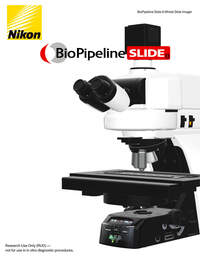
BioPipeline Slide 8 is an automated, medium-throughput whole slide imaging (WSI) system built on Nikon’s industry-standard Ni-E motorized upright microscope and an all-new multimode slide scanning software functionality with motorized XYZ control.
Designed for multiplexed immunofluorescence, H&E, and digital research pathology workflows, BioPipeline Slide 8 brings unattended throughput for high-resolution imaging with the optical performance researchers expect from Nikon Instruments.
Load up to 8 slides, queue your protocols in NIS-Elements, and scan slides rapidly. The system handles autofocus, multi-channel acquisition, large-area stitching, and AI-driven analysis from a single software platform.
BioPipeline Slide 8 is Research use only (RUO) and should not be used for in vitro diagnostics.
The 8-slide stage holds standard 25 x 75 mm glass slides in precision-machined kinematic mounts. Slides drop into place in seconds, and encoders on every axis precisely move the sample for fast imaging.
Acquire multiple fluorescence channels in turn-key step by step protocols. NIS-Elements drives the illumination, motorization, and camera in lockstep.
Acquire multiple high-resolution ROIs on slides without operator intervention — the software handles objective changes, autofocus, and stitching.


BioPipeline Slide 8 software features enable multiple AI tools for automated slide scanning with minimal user interventions.


Hardware-triggered acquisition, kinematic stage repeatability, and per-tile flat-field correction produce a continuous image with no visible seams — even at low magnification across the full tissue section.
Step-and-settle tiling, even with traditional flat-field correction, shows the hallmarks of conventional whole-slide imaging: visible tile boundaries, intensity gradients across each field, and color discontinuities at the seams.
Capture the full slide at low magnification, then automatically drives to ROIs and acquire high resolution images all within a single queued protocol.
BioPipeline Slide 8 is not a box built solely for slide scanning. Use it as an upright research microscope for routine applications as well.