
Nikon Europe B.V. | Europe & Africa
- en Change Region
- Global Site
March 2026
Professor Ukichiro Nakaya of Hokkaido Imperial University (now Hokkaido University), who in 1936 became the first in the world to successfully create artificial snow crystals, encountered a collection of snow crystal photographs taken by American Wilson Bentley 1). Captivated by their beauty and the mysteries of nature, Nakaya began observing natural snow crystals under a microscope in 1932. He famously described snow crystals as “letters sent from the sky,” 2) , and sought to decipher the codes embedded in their shapes and patterns. Through his research, he revealed that snow crystals grow into diverse forms depending on differences in temperature and humidity in the upper atmosphere.
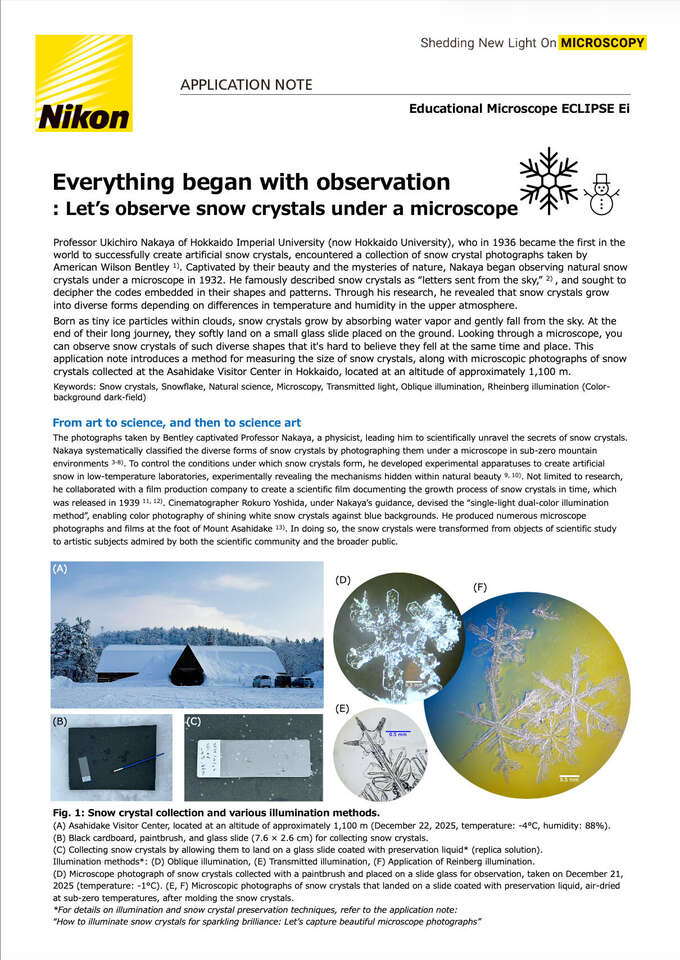
Born as tiny ice particles within clouds, snow crystals grow by absorbing water vapor and gently fall from the sky. At the end of their long journey, they softly land on a small glass slide placed on the ground. Looking through a microscope, you can observe snow crystals of such diverse shapes that it's hard to believe they fell at the same time and place. This application note introduces a method for measuring the size of snow crystals, along with microscopic photographs of snow crystals collected at the Asahidake Visitor Center in Hokkaido, located at an altitude of approximately 1,100 m.
Keywords: Snow crystals, Snowflake, Natural science, Microscopy, Transmitted light, Oblique illumination, Rheinberg illumination (Color-background dark-field)